
Columbus County Criminal History Checks
No single search supplies a complete Columbus County criminal history. Begin with the record that answers the question. The North Carolina eCourts Portal shows filed court cases, events, charges, and outcomes. Court Dates is useful for a scheduled hearing, but a calendar entry is not a judgment. Very recent custody belongs with the Columbus County Sheriff. A fingerprint-supported review of your own statewide record belongs with the North Carolina State Bureau of Investigation.
Gather the full name, likely spelling variants, approximate event date, and any known case or citation number. A name match alone does not prove identity. Compare the county, court division, filing date, and charge before relying on a result. Older Columbus County files may still need help from the Clerk of Superior Court because the county entered eCourts in 2025.
- Search eCourts by name or case number and narrow the location to Columbus County.
- Check Court Dates separately if the immediate need is a hearing date or courtroom.
- Ask the sheriff about a recent booking that has not yet produced a complete court entry.
- Open the matching case and read each charge, its status, and its disposition separately.
- Request older files, certified copies, or a statewide name search from the Columbus County Clerk.
Three Columbus County Record Systems
Booking, court, and repository records are related, but they are not copies of one another. The arresting agency writes an incident or arrest report. Detention staff create a booking record with intake data, initial charges, bond, fingerprints, and custody changes. The clerk then maintains the judicial file once a prosecution is filed. That file tracks hearings, amended charges, pleas, judgments, sentences, and financial entries.
The SBI Computerized Criminal History file organizes fingerprint-linked arrest cycles and matched dispositions from contributing agencies across North Carolina. It can contain events outside Columbus County that a local court search will miss. It can also lag when a disposition has not matched the correct arrest cycle. A person reviewing a disputed result should obtain the Columbus County court disposition before asking the SBI to correct its repository record.
| Record | Best use | Custodian |
|---|---|---|
| Booking record | Recent custody, bond, and initial charge | Columbus County Sheriff |
| Court case | Filed charges, events, and final result | Clerk of Superior Court |
| SBI history | Your fingerprint-linked statewide history | North Carolina SBI |
Official Background Checks in North Carolina
The North Carolina SBI does not offer a general public name-search portal for criminal history. Its official personal-review route is the fingerprint-based Right to Review process. The subject sends a signed packet, a ten-print FD-258 card, identifying information, and the required payment to the SBI Applicant Unit. Results are sent only to the person whose record is reviewed. The current research lists a $14 SBI charge.
For public court history, the Judicial Branch offers a statewide noncertified name search through a Clerk of Superior Court using AOC-CR-314. The stated fee is $25. This product searches court records, not the SBI fingerprint rap sheet. Free courthouse terminals can also search noncertified criminal records by defendant name or case number. Printing may cost extra. Confirm any copy or certification charge with the clerk before ordering.
The federal Identity History Summary provides another subject-only fingerprint route at a researched base charge of $18, with capture or channel fees added where applicable. It covers national FBI history rather than replacing the Columbus clerk search or North Carolina SBI review.
Columbus County Fingerprint Record Chain
A custodial arrest starts one record chain when detention staff capture fingerprints and identity data. That fingerprint-supported arrest information moves through North Carolina criminal-information systems to the SBI and can be indexed against FBI files. The court follows a separate path. Magistrates and clerks record criminal process, calendars, pleas, judgments, and sentences. Clerks later report dispositions so the SBI can link the outcome to the proper arrest cycle.
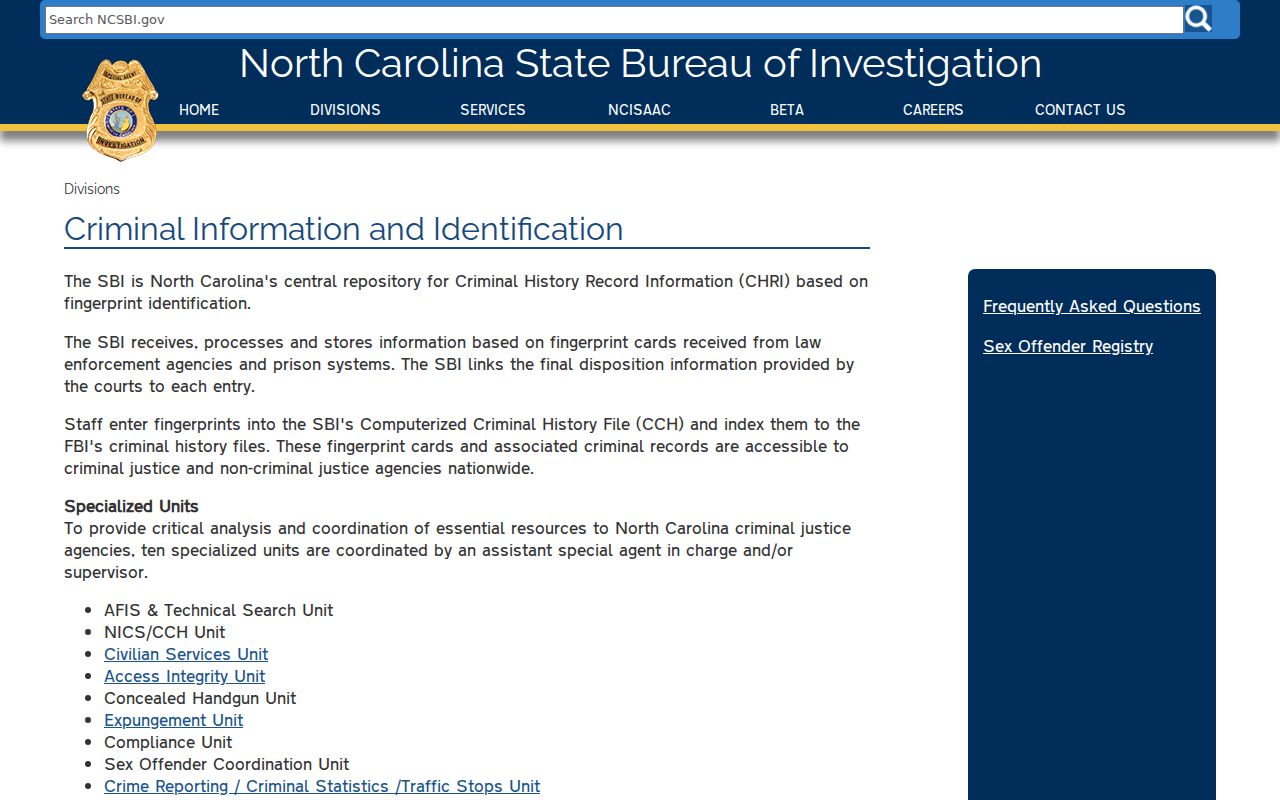
The SBI Criminal Information and Identification overview shows the state repository role. The image below captures that official source rather than a commercial name-search product.
Because arrest and disposition data travel on different schedules, an apparent gap does not by itself show that a case remains open. Match the court file number, arrest date, and final disposition before requesting a correction.
Kinds of Criminal Records
Columbus County criminal records take their meaning from the event and the custodian. An incident report describes what an agency recorded about an event. A booking file concerns intake and custody. A court case shows the state’s filed prosecution. Warrants are judicial process tracked for service. A correctional profile concerns state custody or supervision. The registry serves the narrower purpose set by sex-offender registration law.
- Arrest and booking records: the arresting agency and county detention operation hold different parts of the same event.
- Criminal court files: the Columbus County Clerk keeps the docket, charges, hearings, outcome, sentence, and public filings.
- Warrant records: the sheriff, magistrate, and issuing court can verify process that may not appear on a public list.
- Correctional records: NCDAC covers state prison and some public supervision data, not the county jail roster.
- Registry records: the SBI publishes data for people who have a current legal duty to register.
North Carolina uses lettered offense classes, but a class alone does not predict one fixed sentence. District Court tries misdemeanors and handles early felony stages. Superior Court tries felonies. The filed, amended, and convicted class can differ from the initial booking charge, while the sentencing grid also accounts for prior-record level.
Juvenile, expunged, sealed, victim, medical, and protected investigative material follows separate access rules. Public-record status never means that every field in a file must be released without review.
Columbus County Custody Record Routes
Custody searches depend on where the person is held. The Columbus County Sheriff’s In Custody page links a downloadable report rather than a standard searchable roster. Browser or PDF search can help with that file, and detention staff can verify current status at 910-640-6628. The official iOS app adds an interactive inmate tool, Most Wanted information, registry tools, news, and alerts.
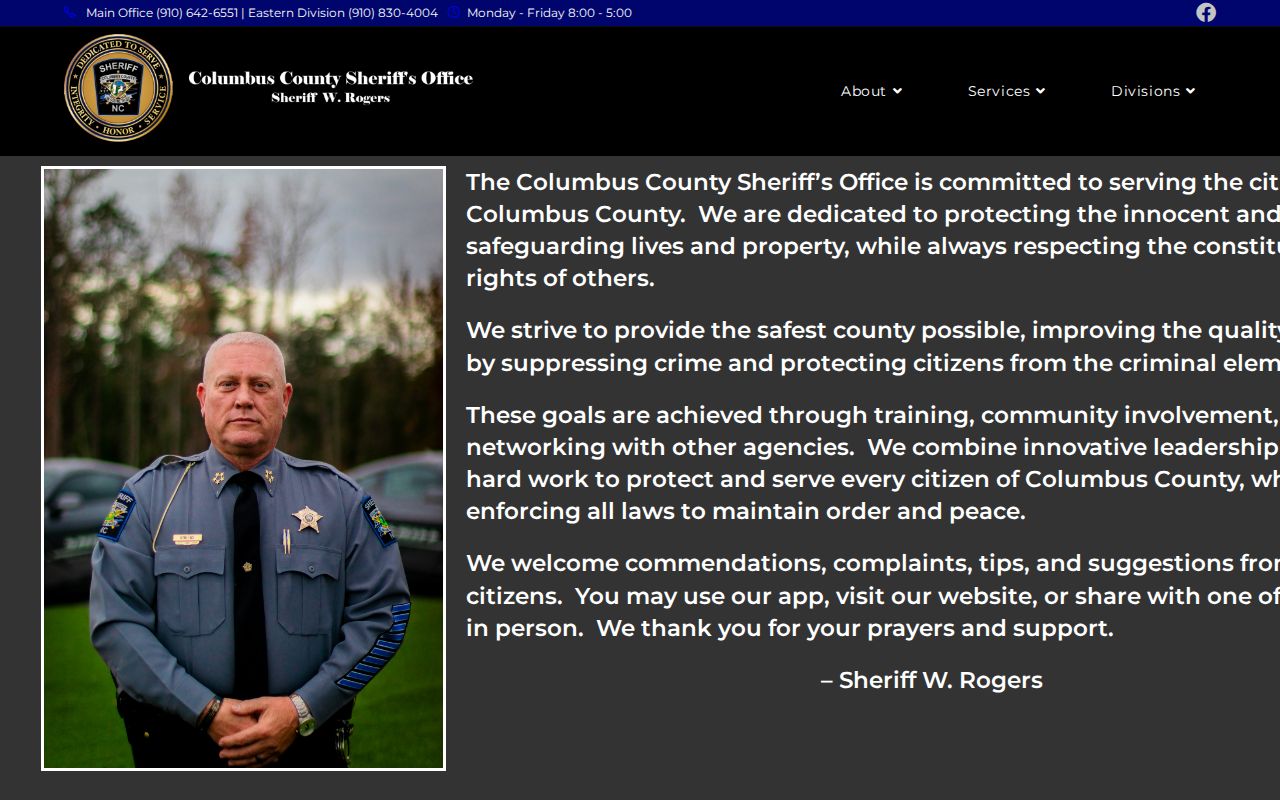
The official sheriff homepage is shown below. It is the source for sheriff-created arrest reports, local booking records, and lawful warrant information, but it does not hold city police narratives or clerk case files.
Use NCDAC Offender Public Information after transfer to state custody. Probation and community supervision are also state-run through the NCDAC Division of Community Supervision, while the Post-Release Supervision and Parole Commission handles its statutory release work. The court judgment shows whether probation was imposed, but operational supervision details are not a public county database.
Use the federal Bureau of Prisons locator for federal custody. VINE can provide supported notifications, but critical custody facts should still be confirmed with the holding agency.
Columbus County Criminal Records: What They Contain
A record should be read field by field. Court summaries may display a case number, filing date, court division, status, defendant display name, counsel, each charge and statute, event dates, bond, disposition, sentence, and public financial data. Document access varies. A docket entry does not ensure that the underlying PDF is free or open online.
An SBI record uses a different structure. It begins with identity data and state or FBI identifiers, then groups fingerprinted arrest cycles, arrest charges, court dispositions, and custody or supervision entries. Confidential identifiers are not part of ordinary public court display.
| Name and identifiers | Names, aliases, and record numbers used to distinguish one person from another. |
|---|---|
| Arrest or booking data | Intake date, agency, booking number, initial charges, bond, and custody changes. |
| Charges and statutes | Each allegation, its offense class, and the law cited in the filed case. |
| Disposition | The result for each charge, such as conviction, dismissal, or acquittal. |
| Sentence | The punishment, costs, restitution, probation, or custody terms ordered by the court. |
| Custody or supervision | Public jail, prison, release, probation, or post-release status where the system provides it. |
Columbus County eCourts Record Shift
Columbus County joined the North Carolina eCourts system on February 3, 2025, in coastal Track 7. Newer case work now moves through the statewide digital setting, yet that conversion did not turn every old paper pleading into a public download. For an older matter, search the portal first, then ask the Columbus County Clerk whether the file, image, or certified copy must be retrieved through the courthouse.
Smart Search accepts names, record or case numbers, citations, attorney details, and other supported identifiers. Advanced fields can narrow a query by location, date of birth, case type, status, or filing range. Search Hearings is meant for scheduled events. Anonymous public access is available. Registration adds saved cases, not a new class of public content.
| Search field | Input | Columbus County use |
|---|---|---|
| Name | Party or defendant name | Check spelling variants and verify the matching case details. |
| Citation number | Exact identifier | Use when the citation is known instead of relying on a common name. |
| Case number | Exact court identifier | The strongest discriminator for a known Columbus County file. |
| County | Location choice | Select Columbus to narrow local results. |
| Court date | Date or range | Limits scheduled-event results but does not prove disposition. |
The post-conversion summary can contain case information, assignments, parties, events, dispositions, hearings, and financial information. Read each charge, not just a broad case status. A calendar proves that an event was scheduled, not how the charge ended.
North Carolina Public Access Laws
North Carolina separates open court records from law-enforcement investigative files. The Clerk of Superior Court keeps court records open to inspection unless another law restricts them. A Chapter 132 request to the sheriff or a police department should identify existing records, not ask the office to research a question or create a new report. A custodian may redact protected data and withhold confidential investigative material while releasing segregable public portions.
Key statutes:
G.S. 132-1 and 132-6 define public records and provide inspection and copying rights subject to exceptions.
G.S. 132-1.4 sets special rules for criminal investigation and law-enforcement information.
G.S. 7A-109 directs clerks to keep court records open unless the law provides otherwise.
G.S. 15A, Article 5 supplies the category-specific rules for North Carolina expunction.
Juvenile data, victim and minor identifiers, medical facts, sealed material, and personal identifiers do not become public merely because someone cites the Public Records Law.
Opening Columbus County Sheriff Records
No complete sheriff copy-fee schedule or dedicated request form was confirmed in the official sources. Contact the Columbus County Sheriff and ask for the records custodian. Describe the incident number, approximate date and time, location, creating agency, and desired format. Ask whether inspection, electronic delivery, or paper copies are available and request a cost estimate before production.
Investigative records receive special treatment under G.S. 132-1.4. A request for the public portions of an existing report is more precise than a demand for an unredacted investigative file. North Carolina requires production as promptly as possible, but it does not set one universal business-day deadline for all requests. Review and redaction may take time.
No verified public Columbus County active-warrant search was found. Verify possible process with the sheriff or magistrate, check any related eCourts case, contact the issuing court, or request disclosable warrant information. Anyone who believes active process exists should call the issuing clerk or a lawyer before attempting an unplanned counter visit.
- Columbus County Sheriff: 817 Washington Street, Whiteville, NC 28472; 910-642-6551.
- Clerk of Superior Court: 100 Courthouse Circle, Whiteville, NC 28472; 910-641-4400.
- Columbus detention: call 910-640-6628 for current custody and booking confirmation.
Restricted, Sealed & Expunged Records
Expunction is the statutory North Carolina term for removing a qualifying record through a court order and later agency processing. Eligibility is tied to the exact section of Article 5. Dismissed or not-guilty charges, certain convictions, identity-theft matters, and some juvenile or young-person matters can follow different forms, waiting periods, exclusions, and review steps. A broad checklist cannot decide eligibility.
Start with the complete Columbus County case disposition. Select the official AOC form for the statute that applies, then file by the method the clerk confirms. A petition is only a request. After an order is entered, the clerk, AOC, SBI, and listed agencies need time to process it. Check both the public court result and your SBI review if an official system still shows inconsistent data.
Juvenile files, confidential victim or minor information, personal identifiers, and protected investigative material have separate limits. Their absence from a public search does not mean that no authorized agency record exists.
Dismissed Columbus County Records Still Exist
A dismissal is a court disposition. It is not the same as expunction. The court file may show that a charge ended without conviction while a lawful booking record still reflects the earlier custody event. An SBI cycle can also remain visible on a personal review until the matching disposition has been received and linked. Treat each record as a statement about its own stage of the case.
If your SBI record lacks a Columbus County dismissal, obtain certified disposition information from the Clerk of Superior Court. Then follow the SBI review and challenge process. If a public portal shows the wrong case status, ask the clerk about the court record itself. An agency that only holds the arrest report cannot change the judicial disposition.
- Disposition
- The final result recorded for a charge.
- Dismissal
- The charge ended without a conviction, though related records may remain.
- Expunction
- A court-ordered statutory process that removes qualifying records from ordinary access.
- Arrest cycle
- The fingerprint-linked event used by the SBI to connect an arrest with its outcome.
City-by-City Criminal Records in Columbus County
Whiteville, Tabor City, and Chadbourn police create their own incident and arrest reports. County detention records still belong to the Columbus County Sheriff, and filed cases go through North Carolina District or Superior Court. North Carolina abolished municipal courts in the unified court system, so none of these places keeps a separate city criminal-court database. The Census incorporated-place tables identify the researched top three, while Census QuickFacts supplies county context.
Whiteville Record Check
4,766 · Police reports start with Whiteville PD; court files are held by the Columbus County Clerk.
Tabor City Record Check
3,781 · Town police reports remain local while bookings and cases move to county channels.
Chadbourn Record Check
1,574 · Chadbourn links a public-record request route and relies on county courts.
Use city population figures only as 2020 Census counts, not as current estimates. A city-linked arrest can produce three distinct records: the police narrative, the sheriff booking, and the clerk case outcome.
Columbus County Courthouse Record Hub
Whiteville concentrates several record and court functions within a small area, but the buildings are not interchangeable. The Columbus County government directory routes county departments, while the Clerk of Superior Court is at 100 Courthouse Circle. The Courthouse Annex at 113 Courthouse Square contains the Public Defender and three courtrooms. The Dempsey B. Herring Courthouse Annex is at 112 West Smith Street. A calendar may name an annex courtroom, so confirm the building before travel.
The county is also part of a federal district. Federal prosecutions do not appear as Columbus County District or Superior Court cases. The U.S. District Court for the Eastern District of North Carolina is the official district source.
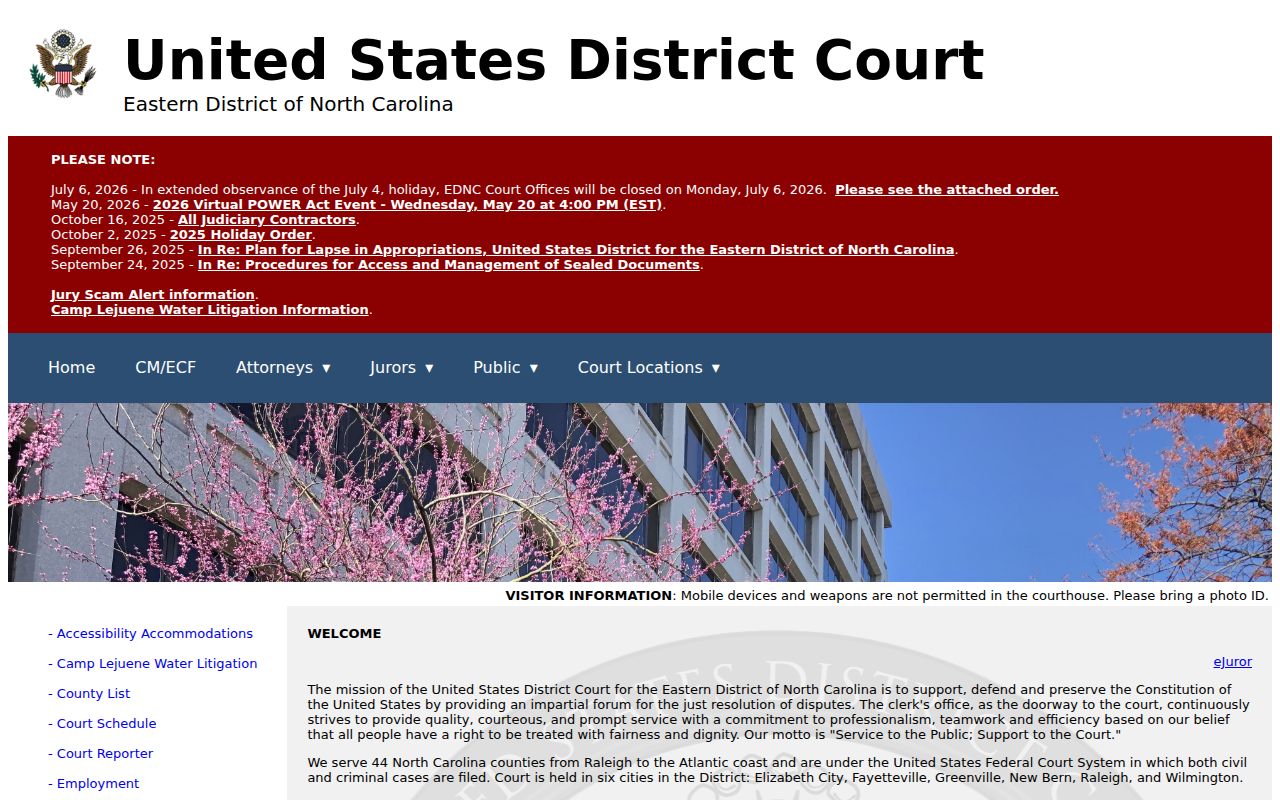
PACER provides federal dockets and documents under its account and fee rules. State custody belongs in NCDAC, while federal Bureau of Prisons custody belongs in the BOP locator.
County statistics also need an official source and a clear date. The North Carolina SBI Crime Statistics program provides the proper agency and year filters.
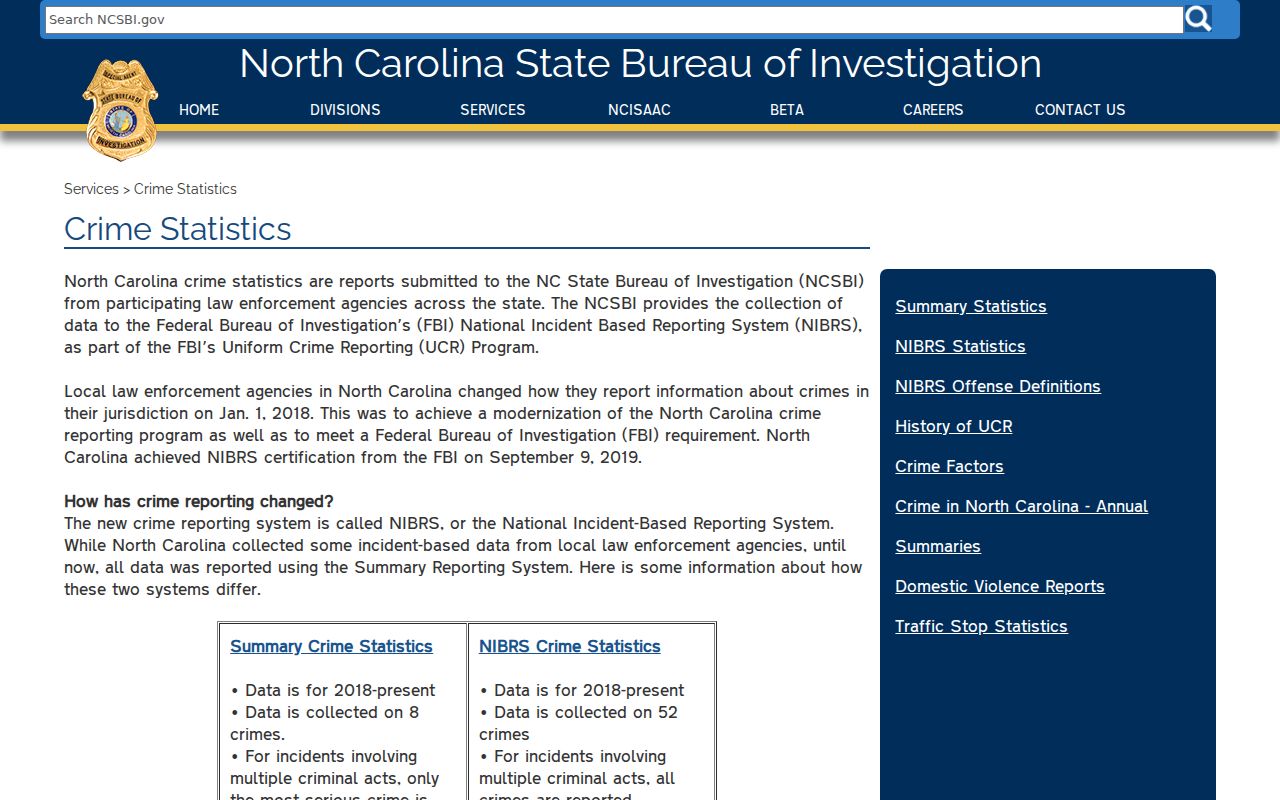
The FBI Uniform Crime Reporting program supplies the related federal framework. Do not turn a single agency count into a countywide rate unless all reporting agencies and the population base align. That limit keeps local record research accurate.